IS ALL THIS BANGING ON ABOUT CHINESE annoying y'all? I was desperate for a hobby, desperate for a heroin-replacement (granted: Chinese wouldn't make a good heroin-substitute for most people, but it does for me). I was also desperate to educate myself. I wish to speak Chinese and Japanese fluently. There is nothing new about this goal, which has been with me since my teens. So I have decided (or fixated) on training myself up as a translator. To be a qualified translator, you need a postgraduate degree on top of a language BA. Most translators can offer at least two languages on top of their own, so there is no conflict between improving my German and French and studying Chinese. Especially as I could do that post-grad in Germany, which would effectively qualify me to translate Chinese into German as well as English. German is the number one business language of Europe (after English, of course) and Chinese, as we all know, is the most-spoken language anywhere on earth. So I doubt I'd be out of work... I've been looking into BA courses in Chinese actually in China. Annual tuition fees start from about £1600 ($2500US) pa for four years. One of the websites I consulted complained that many of these courses concentrate on reading and writing at the expense of listening and speaking. But who cares, when you can pop outside to an authentic Chinese noodle-stall and listen and speak to your heart's content? One major major hurdle is that every course I have looked at imposes a meximum age limit of between 30 and 40 years ~ I am 39 next spring. But where there's a will there's a way. I have a cunning plan up my sleeve that might hopefully put some oomph behind my appeal against this ridiculous regulation. Oxford, Cambridge and London universities offer Chinese and Japanese studies, but the prospectuses state rather bafflingly that a prior knowledge of the language won't help your application that much. Plus they specify that their courses aren't suitable for native speakers. Looking closer I see why: these courses promise only to take you to about a year past A-level ~ which is where my German is now! Which all in all suggests that if I cannot do Chinese in China I may as well get on to a "Sinologie" course in Germany, killing two linguistic birds with one stone. I desperately need a copy of Hammer's German Grammar (the standard advanced reference work). My written German is still pretty dire ~ despite my daily blogging attempts. I'm having less and less trouble reading zentraleuropäische books and websites as time goes by, which shows I'm at least making some progress. (And I do know the German for a corpse (eine Leiche), which means I can describe my face in the mirror at six in the morning...) I do apologize once more if my whittering is boring. I have a slightly obsessive temperament, you might see... Which also might explain why I've found heroin so very hard to kick. Right from the word go I had a sense that my drug addiction had turned my strengths against me ~ so now my strengths were weaknesses. When I love something I give it everything. I have loved "B" like nothing else. So I gave my entire life to heroin. And that, my friends, has been the crux of my problem...
Illustrated: Chengdu (top), home of the University of Sichuan... famous for its Szechuan chicken (bottom)!
Chinese for today: Zhe4 这=this shi4 是=to be ren4shi 认识=recognize zhen1 真=really gao1xing4 高兴=happy bei1 杯=cup jiu3 酒=alcohol ba 把=suggestion particle ne 呢=question particle hui4 会=know how/can/will ju2zi 桔子=orange 橘子 also = ju2zi, orange ju2zi-zhi1 橘子汁 / 桔子汁 = orange juice ma 吗 = question particle
The numbers refer to tones: 1 high level; 2 high rising; 3 mid-low-mid dipping 4 falling. No number=neutral tone (the de facto 5th tone).
STUPIDLY I went and downloaded the most up-to-date PDF Broschüre for the course I have set my heart on. I hate setting my heart on anything, because I might not get it. But I've set my heart on this. The desire to do it is eating me up inside. In fact I feel like I'm festooned with army ants and being eaten alive. I feel like a hydrogen bomb inside me is about to detonate at any moment.
This is what they say about the languages on offer, re the application process:
3.2 Zulassungsvoraussetzungen Für das Bachelorstudium besteht in den Sprachen Englisch, Französisch, Spanisch eine Zulassungsbeschränkung (Numerus clausus). Der NC-Wert ergibt sich für jedes Semester neu aufgrund der freien Studienplätze, der Abiturnoten, der Wartezeiten und der Anzahl der BewerberInnen. Eine Vorhersage über die für das jeweilige Zulassungsverfahren geltenden Grenzwerte kann daher nicht getroffen werden. Als Zugangsvoraussetzungen für das Studium am FTSK sind neben der allgemeinen Hochschulreife oder einem äquivalenten ausländischen Abschluss fundierte Kenntnisse in Deutsch als Fremdsprache, Englisch, Französisch und Spanisch und Grundkenntnisse in Chinesisch erforderlich, falls diese Sprachen als Fächer gewählt werden. Genaue Informationen zu den Eingangsvoraussetzungen für alle Sprachen entnehmen Sie bitte den Merkblättern der einzelnen Sprachen, die Sie auf der Seite http://www.fb06.uni-mainz.de/261.php finden.
Well I have to read it in German ~ so can you!!
To summarize, English, French and Spanish ~being so highly popular, are subject to entry restrictions in numbers. Being as English is my mother tongue and the only language over which I feel I have some genuine mastery, I don't have much choice in the matter. But I can avoid French by not applying for it, and doing Russian instead, as I've already decided. Some basic knowledge of Chinese is required. So I'm determined to trounce the other students by achieving A Level standard (or higher) before I even start. As you cannot fail to have noticed, I have a genuine fascination for Chinese characters. I already know about 2-300. If I could multiply this by a factor of ten, I'd have a pretty good basic reading knowledge in Chinese.
I couldn't find any entry restrictions or requirements for Russian, but would feel compelled to reach at least GCSE (lower school certificate) level, simply to underline my interest (and distinguish myself from the vulgar hoardes I'll be up against in the application process). The greatest novelists of all time wrote in Russian ~ Tolstoy, Dostoyevsky, Gogol, Turgenyev, Pasternak... imagine how amazing it would be to read those in the original?!
My biggest worry of all doesn't concern waiting lists because I'm English or beating others at Chinese: it's the German language test to which I'll be subjected. I tried on before on the Goethe Institut website (admittedly when my German was clagged up with 18-years of unpractised rust) and got a dreadful score.
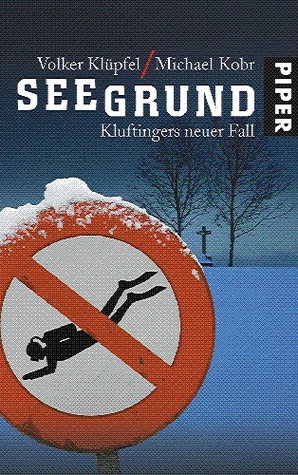
As I shall point out, not having a teacher here, I have focused my energies on acquiring a passive reading vocabulary. And it's working amazingly. The novel I'm reading, Seegrund, which means Lake-Bed is a thriller about a dead body found... you guessed it. In a pool of blood in the snow on the banks of a frozen lake. I was astonished to comprehend the words for river-bank (das Ufer) and corpse (die Leiche) ~ both of which I've picked up and remembered in the past couple of months. So you see reading books and keeping my amateurish German blog has got me somewhere after all. There are many expressions for which I know two or three words in German, just as I do in English. I get a real sense of achievement from this. Especially as I DROPPED OUT of a languages degree in the early 90s in disgrace and despair, convinced I would never achieve any degree of mastery over German, let alone any other tongue. Somehow, amazingly, the magic has happened.
I think my turning point came one night as I listened to BBC World Service radio. I realized that across the world there are millions of people who have never set foot on Anglophone soil, who have learned to speak our language fluently by following radio broadcasts and slogging their way through English literature, dictionary in hand, referring and re-referring constantly to every word they're not entirely sure about. So I did this and look! I'm seriously considering applying to uni in Deutschland. How amazing is that. Six months ago I wouldn't even have been able to read the prospectus... Well enough of my babbles.
It's 5:34. The clocks went back last night, meaning darkness now falls not long after 4pm. It's dead romantic ~ like a Siberian goods train yard full of onion-picking babushkas, with immigrant workers hiding in the cattle trucks smoking Cyrillic cigarettes and babbling away in Chinese. (I must fit the two new languages into this silly fantasy.) German, Russian and Chinese are also, of course languages of the former Communist Block. Life behind the Iron Curtain has long held an enduring fascination for me. That was a big reason why I so loved German doing at school. When I started the A-level course Germany was separated by 200 yards of watch-towers, searchlights and tripwired minefields. By the time I actually sat the exams the wall had come tumbling down and a new world order was upon us.
What the future world order shall bring, I shudder to think. It's capitalism capitalism capitalism everywhere. I'm a capitalist, but I see excesses everywhere. And greed is not always good, despite what Gordon Gecko would have us believe. Anyway I must ping. I wonder if anyone actually read this post to the end? If so, I commend you with a 金奖章jīn jiǎngzhāng ~ a gold medal!
PS Here's an entertainment for you: the oldest recording JRR Tolkien, author of The Hobbit, The Lord of the Rings, et al... he appears in this early English Linguaphone course in units 13 "the wireless" and 20 "at the tobacconist's"! What a blast from the past. (He was well into his "pipe-weed" as anyone who's seen the films will know...)
... SO YESTERDAY I SPENT MY DRUG MONEY ON BOOKS (and food). £10 got me a 972-page German tome called Der Turm (The Tower") by Uwe Tellkamp. £3.50, beautiful hardback with acid-free cream paper. Set in the former DDR... well I can't tell much about it as I'm only on page 7. But it's set behind the Iron Curtain and I have a thing about life in former communist states. The other books were give up smoking for 50p, Byron Childe Harold/etc 30p special offer (minuscule hardback) and Peyton Place (80p) by Grace Metalious, who died of alcoholic cirrhosis at 39 and sold well over 20,000,000 copies of this book about moral degeneracy in a drab New England Town. This reprint comes with intellectual introduction by some academic and I have to say Metalious's literary style isn't bad (nowhere near as bad as Jacqueline Susann's, if you're into trash fiction of the 1950s and 60s).
The rest of my tenner went on food.
I was actually hoping for Teach Yourself Mandarin Chinese book and CD set for £5 (well I can hope, can't I?) but Mandarin will have to wait till next week.
The urge to educate myself is eating me up inside. An all-consuming craving, far worse than any drug-craving I've experienced for a very long time.
Today will be a test day. I KNOW a friend who will come to me in need (he always does) and how on earth I will get out of that situation without scoring heroin I have no idea.
By the way there is a terrible drought on at the moment. The drug purity has fallen ~ even in the best stuff I've found ~ to less than a third of what it normally was. I can tell this by the way methadone holds me so much better than any street heroin I've bought in weeks.
My favourite hobby is complaining about the lousy gear. So people assume I'm being ripped off, introduce me to their dealer and I'm even MORE BITTERLY DISAPPOINTED with minuscule bags of even poxier gear!
In my opinion anything that's not China white is rubbish anyhow. Heroin is properly white, not brown.
The worst stuff that was around can't have been more than 1% pure ~ if that. And it was full of some sort of resin that re-congealed on cooling, making the stuff uninjectable unless you filtered it three times.
The root of the shortage is blight on Afghanistan's poppy crop, reducing this year's opium yield from around 8000 tonnes (enough to make 800 tonnes of heroin) to something like 2500 tonnes opium (250 tonnes heroin). The UK alone uses an estimated 35 tonnes annually (at import strength), so if there's blight next year it's curtains for heroin (hurrah!)
Hurrah, because I can be free. I feel like a pan of boiling water, seething with pent-up energy and furious steam. One day I will go out and smack the world right between the eyes, because the world deserves it.
Meanwhile I have to 1. give up heroin 2. learn fluent German 3. write several bestselling books 4. learn fluent Chinese 5. learn fluent Russian 6. get on course I've been wittering on about 7. graduate with summa cum laude or whatever the phrase is.
Then at long last I will be qualified to do something.
When I was little and heard foreigners going blubble-blubble-blubble, I thought they all spoke one language called Foreign. I was determined to learn this mystery tongue, so nobody could prattle over my head again.
Also I was affronted by the way almost all foreigners appeared to be fluent in English, giving my family, friends and I no linguistic privacy whatsoever almost anywhere in the world.
My goal is to speak at least 10 languages fluently, including Arabic, Spanish, Japanese, Thai ... blah blah. If I'd only not been so incredibly lazy all my life I could be a long way to achieving this goal. As it is, I barely speak fluent English!
My goblin-bitten computer cable replacement is here! Whoopeee! Now I must run in the shower. I'm so minging I'm infectious...
I AM STILL DEAD SET on doing this uni course. The prospectus says you can choose an A-language (your mother tongue, in my case English); the B-language would automatically be German. These two languages you learn to translate into and out of (written translation; interpreting the spoken word is another skill entirely and you can't do it at home in pajamas, so I'm not into that...). Translating INTO a foreign language is a tall order, so I need to get as far beyond my A-level German as possible. They say they have 800 students with mother tongue English on these courses (Bachelor and Masters), so to get in I will need to distinguish myself as much as I possibly can. The C-language can be any one of: Chinese, French, Italian, Modern Greek, Dutch, Polish, Portuguese, Russian or Spanish. This language you translate out of, into your mother tongue ie Chinese to English. I would luuurve to speak Chinese, it's one of my life goals (as well as Japanese, which isn't on the syllabus). The D-language, which is entirely optional you don't learn to translate, you just learn it. The choices are: French, Italian, Modern Greek, Dutch, Polish, Portuguese, Russian and Spanish (note Chinese isn't there). Originally I would have gone for French, which I already have A-level (higher school certificate) in.
Having banged on ~ quite truthfully, of course ~ about WHERE THERE'S A WILL THERE'S A WAY in my previous post, I realized I was limiting myself by present circumstance and convenience. If I could have a magic wand waved over my head and speak fluent French, Italian, Greek, Dutch, Polish, Portuguese, Spanish or Russian ~ I'd actually choose Russian.
So Chinese and Russian it is. And I don't see why I should compromise.
So I'm on a hunt for Linguaphone courses in Russian and Chinese. I need to get as fluent as I possibly can before applying. If learning those two from scratch simultaneously sounds a tall order, just bear in mind it's what I'd be doing at uni anyhow ~ if I can prove I've done it myself, at home with no teacher, just CDs and books, and if I can get my German as fluent as I possibly can, this will stand hugely in my favour when I apply.
I'm not too worried about having to account for my lost years. Nobody is owed an explanation for my life and I can justifiably claim ill-health.
You see I'm working to convince myself here, not you, but if you have any comments I'd be glad to hear them.
I wouldn't expect even to apply until this time next year at the absolutely earliest. Interviews for college places are generally held the following spring (2011). And I wouldn't be able to start until October 2011. This feels very fast. I cannot really envisage myself commencing until the year 2012. And as I say, for a course like this, which is obviously going to attract the crème de la crème (nobody leaving the British educational system at 18 would have German good enough to go straight to a course like this, unless they had German family or some other advantage ~ the standard of language tuition in this country is abysmally low...
... so these are my thoughts for today. Hope I haven't bored y'all too much ...!
PS My apologies for having visited NONE of you for AGES. Until my goblin-nibbled cable replacement comes I'm limited to half-hour dashes at the local internet café...
DO ANY OF YOU REMEMBER the language course I found in Germany that I was banging on about some months ago? It's the only course on the face of the earth that I actually want to do, because unlike a straight language degree it's actually a course in TRANSLATION, so it would qualify me to do something I know I'd be good at.
Plus I could study German and two other languages.
If you're reading this on American soil, you need to bear in mind that European university courses are always specialist honours degrees. There's no "major" as such. You do a degree in English or law or physiology or whatever with little scope to "read" much else. Which was part of my problem before. I had too many interests...
Last year's prospectus annoyed me because there's an undergraduate version (for me: I don't have a bachelor degree) plus a postgraduate version for those already in posession of a BA. The only difference so far as I could discern was that the postgraduate offered Chinese in the list of available "C" languages, whereas the undergraduate version didn't. Which really annoyed me, as I'd love to do Chinese. It's not that difficult, I never had trouble with tones when I learned holiday Thai some years ago, plus I have a good memory for characters. You might have noticed over time that I have a thing about foreign scripts. I think most of them look really funky.
Anyway I just checked and they've CHANGED THE PROSPECTUS so I could now do exactly what I wanted to: English-German/German-English Chinese-English (translation) + French (not to translate, just to speak it). I already have A levels in German and French.
Also I just found out that those German ICE trains, due to depart London-Frankfurt within a couple of years would take me to within an hour of Mainz, which is where that course is... is this a sign?
I have already started and dropped out of TWO uni courses... perhaps as the saying goes "third time lucky". I don't know how on earth I would fund this, though we ARE in the EU for the time being, so I ought to be eligable for local as well as European funding, especially as I would be studying two European languages. German tuition fees are a fraction of those in Britain (which are about to skyrocket). The only way I can think of paying my way through without ending up in huge debt would be to write a bestseller.
If this course is so unsuitable, I don't understand why I keep coming back to it in my mind. I've not found one like it anywhere else.
As the saying goes WHERE THERE'S A WILL THERE'S A WAY. And you're supposed to keep your eyes on the goal, not the obstacles.
My legs are almost healed now. Valium Marilyn whose eyes are up the wall has STILL not seen a doctor. I told her to go to her own, who knows her, knows she hasn't got a "lazy eye" and will see straight away what's wrong, and probably know what it's likely to be.
Anne Diamond, former presenter of breakfast TV, was standing in for Vanessa Feltz who's on her hols. I've phoned in and spoken to Anne Diamond before now and have to say she's very engaging. I can see why she's such an illustrious track record in presenting... Anyway here goes. A level results were out today. The conversation yesterday (on BBC London radio 94.9) was about young people going to university and the extortionate cost of this:
Good morning Anne In days gone by ~ generally speaking ~ a degree was was a luxury. Three years off in which to delve into a subject of personal interest. The resulting degree proves to future employers that you're intelligent enough and have the sticktoitiveness to achieve a bachelor of arts or science. With the exception of some science subjects and perhaps law, the degree never was meant to "qualify" you for anything in particular. The problem nowadays is that with so very many young people going to university, a degree no longer sets you apart. As far as I can see, in most cases it merely gets you into debt. In my day~ two decades ago ~ the standing joke was "What do you say to a sociology graduate? Burger and fries please." Change that to "media studies" and you're bang up to date! Nearly 20 years ago I read modern languages at uni, but sadly had to drop out due to health difficulties. Knowing what I do now, I would advise a young person to take a vocational course with a clear career goal at the end of it, or to do languages. At least languages are useful and open up opportunities to work abroad. I would dearly like to go back and finish my languages degree, but this time I'm working on getting my German fluent enough to get on a mother tongue German course actually in Germany ~ where tuition fees, incidentally, are a fraction of what they are here.
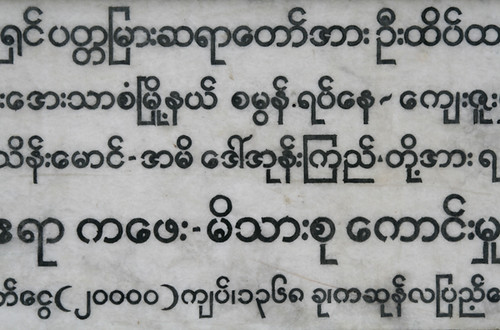
The health problems that forced me to drop out were basically depression. I was signed off an entire term on medical grounds at one point. When I left, I was coming to a point where I had to go to Berlin ~ a year to which I'd really have looked forward, if I'd only been in my right mind. But I was not in my right mind at all. Taking a year out or "intercalating" was not an option as I had no means of support and the DSS did not at this time pay benefits to anyone who was a registered student ~ whether actively studying or not. All modern languages courses require a year out in the appropriate country. The only course I've ever come across that doesn't is Burmese at SOAS. The Burmese language has the world's most beautiful system of writing. And a degree in Burmese ain't gonna be any less useful than one in English literature or sociology, is it..?.For obvious reasons, a year spent in Burma is not too practicable. And it was indeed the idea of doing a German degree again that got me reading and blogging in that language. I remember my former counsellor, who'd done BA French, informing me it was quite normal for degree students to rely on English translations when doing European literature. Which I found truly pathetic. (I thought it was just me and my dreadful command of languages who was reduced to this, but apparently not at all...) So I decided if I ever did go back I would know German well enough to surf through all books in the original first time around. And no reference to any translation. At all. Ever ...
ENYA: EXILES I've found this tune going round and round my brainbox of late. Cold as the northern wind and December mornings ... It matches my mood ... For a couple of weeks now I've had an unaccountable autumnal feeling, despite it still being "summer". Summer is over for me. Darkness surrounds us. I feel it. O, how I feel it..
COMPETITION ANSWER: No prize, except the satisfaction of knowing how knowledgeable y'are... the squiggles are GABELSBERGER SHORTHAND in the German language. Unlike traditional English language systems which are geomatric (Pitman, Sloane-Duployan) or cursive-geometric (Gregg), Gabelsberger's method employed a full shorthand alphabet (as the hieroglyphic-looking Teeline system does in English), giving the squiggly appearance. It has been praised for having "a beauty of form and outline that is unsurpassed". it can also be squiggled, so it is claimed, at speeds of up to 500 syllables per minute, which ain't bad!
I STILL WANT A tiny Norwich or cairn terrier, but I don't know when it's ever going to happen...
I'm trying to get my life in focus by brushing up these languages to university-entrance standard.
I tell myself that if I don't do it the weeks will fly past anyhow and nothing will be done.
The trick is to use the time wisely and constructively. So I've had to construct a course of my own where I find Youtube reports in German and French, watch through them. Usually I have a good gist of what was said. I listen again, sentence by sentence, word by word. Every word I am not 100% sure of ~ or that I understand (passive vocabulary) yet would not think of using (active vocabulary) I add it to my list... Next I have to watch the video through once more, the new words fall in place. Ideally I would compose some sort of essay using this new vocabulary. This is how most language courses work. I'm just going to have to be disciplined enough to push myself through.
I've been floating over French and German blogs, but, in German especially, haven't the confidence to comment...
It's a shame the "civilized" regulations of modern society mean it would be difficult to take a doggie to college ... I thin I'm going to have to sacrifice the furry swine ~ not an OSPCA-type animal sacrifice... well y'know what I mean.
As it is I'm depressed. I'm tired. It's dark already. The day has flown past. Close to midnight already. I have learning to do...
NORWICH TERRIER CARE: Look at the poor little swine enduring all this:
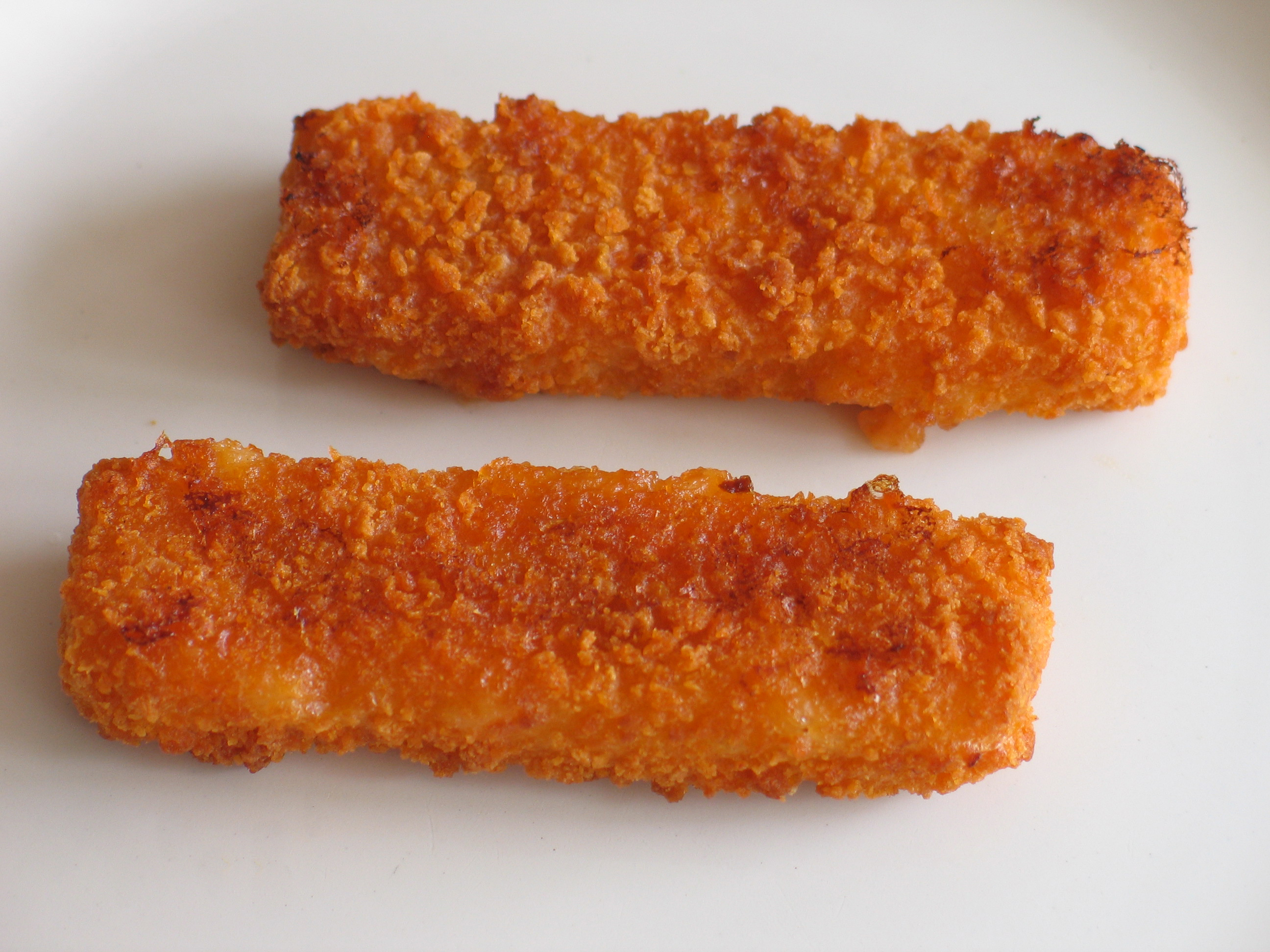
... das Fischstäbchen, de visstick ~ I think they're known as fishsticks in America, too.
I have been practising these languages in the most practical way I know how ~ by writing out trilingual shopping lists: die Milch/le lait/de melk (and just for good measure, Esperanto: lakto)... deze vissticken of mine come in cod ~ der Kabeljau/la morue/de kabeljauw/moruo and haddock ~ der Schellfisch/un aiglefin/de schelvis/eglefino ~ I bought both (special offer/Sonderangebot/promotion spéciale/speciale aanbieding/o Esperanto can go hang it's late... it seems to have taken all evening just researching 20 words, with much continental Wikipedia comparison... driving me round the twist. I really need printed information.
I've continued researching educational opportunities, but feel my old chasing rabbits in two directions syndrome threatening to reappear.
I am referring to that Chinese proverb I've mentioned before: he who chases two rabbits goes home empty-handed and it has been the story of my life. Full of interest in too many different things I'm unable to focus and very little comes of the efforts I do put in. Well now I'm too old, and will have to sit down and do something constructive (and profitable) before I die. I now realize that an undergraduate degree does not have to, and indeed is not meant to, encapsulate your interests in every academic subject going. It is quite OK to be well into one thing but to do a degree in another. When I was younger I was also against vocational degrees. At the more intellectual end of academia they were unfashionable and only the "new universities" (that is: the former polytechnics") tended to offer them. I was all into penning great intellectual critiques on classic works of literature (which I was good at, when I gave myself a chance). The idea of business German, to me seemed soulless.
Anyway I've had a peruse around the subjects that interest me. For the record these are basically European and Asian languages: German with one or more of: Japanese, Dutch, French, Chinese, Italian or Spanish. These are the languages I want to speak. Those are my goals. Obviously there are three or more BAs there so I'll have to be selective...
Oxford do what sounds like a very good FIVE YEAR course in BA Japanese ~ which includes one year abroad. In five years' intensive study I would expect a very high level of fluency to be attained.
There are several universities in Germany offering Germanistik/Japanologie at BA. To get on one of these courses I would need a very high level of German proficiency as (unlike the translator's degree in Mainz) they are squarely aimed at mother-tongue German speakers and any language exercises would refer back to German...
Perhaps studying a third language through the medium of a second sounds very high-falluting ~ but students with English as foreign language study in British universities all the time, so I don't think it would be that unusual for me to do the equivalent in Germany...
Now I do really want to learn Japanese and I love the subject and when I pore over my kanji books I feel centred in a way that only heroin and novel-writing could ever compete with...
But I have to bear in mind, the point of any degree would be to get me as near as possible to QUALIFIED to do something, namely to translate. And I think at my age I really need to focus energies where they are best spent... Common sense tells me that for a translator, a course in translation would obviously be the way to go. I already have French and German to A level, which represents five years' study (seven years in the case of French)....
Bearing in mind that Birkbeck's Japanese promises to take students from ab initio to "one year post A-level" and you see how much further I could take German and French. The course I'm looking at promises "near mother tongue fluency" ~ which is considerably further along.
Whatever I decide to do I am going to have to focus my energies economically. If I want to do a European D language on top of the other two I need to start that now. Three languages at once isn't quite as confusing as it sounds ~ remember I'm pretty much at book-reading level in the other two, so my hellos, how are you? ~ please would you be so kind as to direct me to the railway stations... shouldn't get into too many tangles.
In the BA programme, as a native speaker of English you can either study German as your only foreign language (B language, excellent active competence), or you can choose a second foreign language (C language, excellent passive competence), which can be Dutch, French, Greek, Italian, Polish, Portuguese, Russian or Spanish. (Please note that there are admission restrictions for French and Spanish.) Ab initio courses are not offered in all C languages. However, you can attend introductory courses in Finnish and Turkish (D language).
(Every language offered as a C-language can be studied as a D-language also.)
Without any school certificates in Spanish, it doesn't sound like I'd be able to take that (the most obvious practical choice of D-language) anyhow. Another factor to bear in mind is the competition: loads of professionals can offer Spanish. As far as I know it is now the number one most popular choice of foreign language in British schools (being easier than French and, people suppose, more useful, though I'd dispute that (the number of speakers might be lower, but French is extremely widely spoken)). German is least popular of the big three ~ and yet, so I hear, there is more work for professional linguists in German than every other EU language combined! Perhaps Italian would be the most "sensible" choice. Finnish appeals because it is non-Indo-European (related to Lappish, language of the mysterious reindeer-herding Saami) ~ hence difficult and exotic ~ from a land of lonely pines, ice-lakes, snow-capped crags and the midnight sun... Italian: best food in Europe, easier than French (and much more crisply pronounced)... classical ruins, great literature and poetry and opera... high fash in Milan, porn stars in parliament. Yeah: Italian is cool. But none of those others really grabs me. To learn any language it's essential to be exceedingly highly motivated and the fire isn't there.
As for Dutch, I've already prattled on about that before: Mainz is only a couple of hours from Dutch-speaking territory, I already have studied the basics of Dutch grammar and it's easy. As you can see from the examples I gave, most vocabulary echoes both English and German. And when I studied Dutch I felt centred, in the zone... like I do with Japanese and heroin (strange but true).
I need to make up my mind soon... and now it's a quarter to midnight, nothing has been done. I am drowning in word lists for fish, bread rolls and tomato sauce... How do I come up with a programme, by myself, to focus the skills I need to build up? (Without wasting time or running round in circles..?)
I have lost one decade solid of my life to heroin and mental ill-health. The decade before that was pretty much scuppered by health concerns, too ~ though I wasn't a full-on addict (it's difficult to date precisely when which problem began because they're so interwoven and in the beginning I was extremely cautious with heroin. I had no intention of getting addicted and so continuously "picked it up" (as NA say) ~ loved it, but forced myself to renounce it. This happened again and again over a period of years. Somehow the occasions when I used crept closer and closer together until I found myself withdrawing without even knowing it!... And THAT is a long story...
Now I must go. Has anyone any advice on what I should do? And how??
Here's an some interesting stats: TOP 10 INTERNET LANGUAGES by number of users: www.internetworldstats.com/stats7.htm English is number one with just under 500 million, Chinese number two with just over 400 million. German comes just ahead of Arabic ~ about 72 million... French is 57 million...
MUSIC: KAREL FIALKA: HEY MATTHEW Produced for just £200 from the singer's Bradford & Bingley account, this got to #2 in the UK chart, it's called "New Wave" and that's it really
OK I'll try and be polyglot: Deze hier is een £200 productie van het engelse sangschrijver Karel Fialka. Het is wel goed. Och! It moet nu gaan! Ik heb niet maar toe zeggen! OK, tot later
IF I'M GOING for this uni course in French/German/Dutch translation in Mainz I'm going to have to refresh my rusty French (no study in 18 years) on top of my German. I did study some Dutch when I was enamoured with the idea of moving to Amsterdam and completed half a Linguaphone course, which means in theory I would have had a vocabulary of about 700 words... but THAT was 18 years ago too!
So I decided the thing to do is give up entirely googling anything in English and migrate exclusively to their French, German and Dutch portals. I have just been reading up on blue roses and la situation linquistique en suisse (Switzerland) on French Wikipedia.
Looking back I can see I have been extremely lazy in my attitude. But I also see that my attitude has been nothing unusual for an English-speaker. In many parts of the world it is quite ordinary to have to read books, conduct business and look up information in one's second, third or even fourth languages. I think if I can pick up this attitude, instead of grumbling to myself that this is "like looking at a beautiful view through a dirty window" (which is pretty much what it's like having to read a text in an idiom where not every word is familiar and a few are downright incomprehensible) and remind myself that I'm killing four birds with three stones (or whatever I'm doing: what is the metaphor? I'm killing two birds with one stone three times then.)... If I can do this then maybe I will qualify to get on that course, maybe I'll actually get on it, maybe I'll go and do it and graduate with flying colours and everything will change for the good. I can but try (!!)
I HAVE FOUND a degree course where, even as a mother-tongue English-speaker, I could spend the entire three years studying BA German in a quaint historical town in Germany.
The idea of possibly having to move city in the UK to study a language spoken only a few hundred miles across the water always did strike me as bizarre. If you want to learn German, go to Germany!
The course is called Translation with Cultural Studies (Translations-, Sprach und Kulturwissenschaft) at the Johannes Gutenberg Universität in Mainz. Instead of spending three years reading great literature (which would be very nice, but a huge indulgence; also the amount of reading required on a literature course is momentous) ~ I would study German as my main foreign language (the so-called B language; English, as my mother-tongue would be the A language). The goal being to be able to translate into and out of the B language with near mother-tongue fluency. I would then pick a C language (French), which would be brought up to “excellent passive fluency” ~ ie you translate out of French into German and English (but never vice-versa). There’s also an option to do a D language, in which case I would pick Dutch. As y’all can see from yesterday’s post, Dutch stands midway between German and English on the dialect continuum, so it’s not particularly difficult to pick up.
I don’t know any UK institution where I could learn German, French and Dutch all together. People have always queried why Dutch? Even a student of BA Norwegian expressed astonishment at this Wunsch of mine. Dutch-Flemish has over 24 million speakers in the EU (plus six million more in South Africa as Afrikaans), which is far more than all the Scandinavian languages put together. Looking at the map, French and German form a massive block of central Europe, and Dutch fills in the gap both geographically and linguistically. Dutch is the closest major relative to English, which is a cross between French and Germanic. So the four languages tie together nicely. See: there is some method to my madness! I just think it’s amazing I finally found a course where I can do everything I want in the right location. (I’ve always wanted to do German in Germany but until I found this course it didn’t seem possible.)
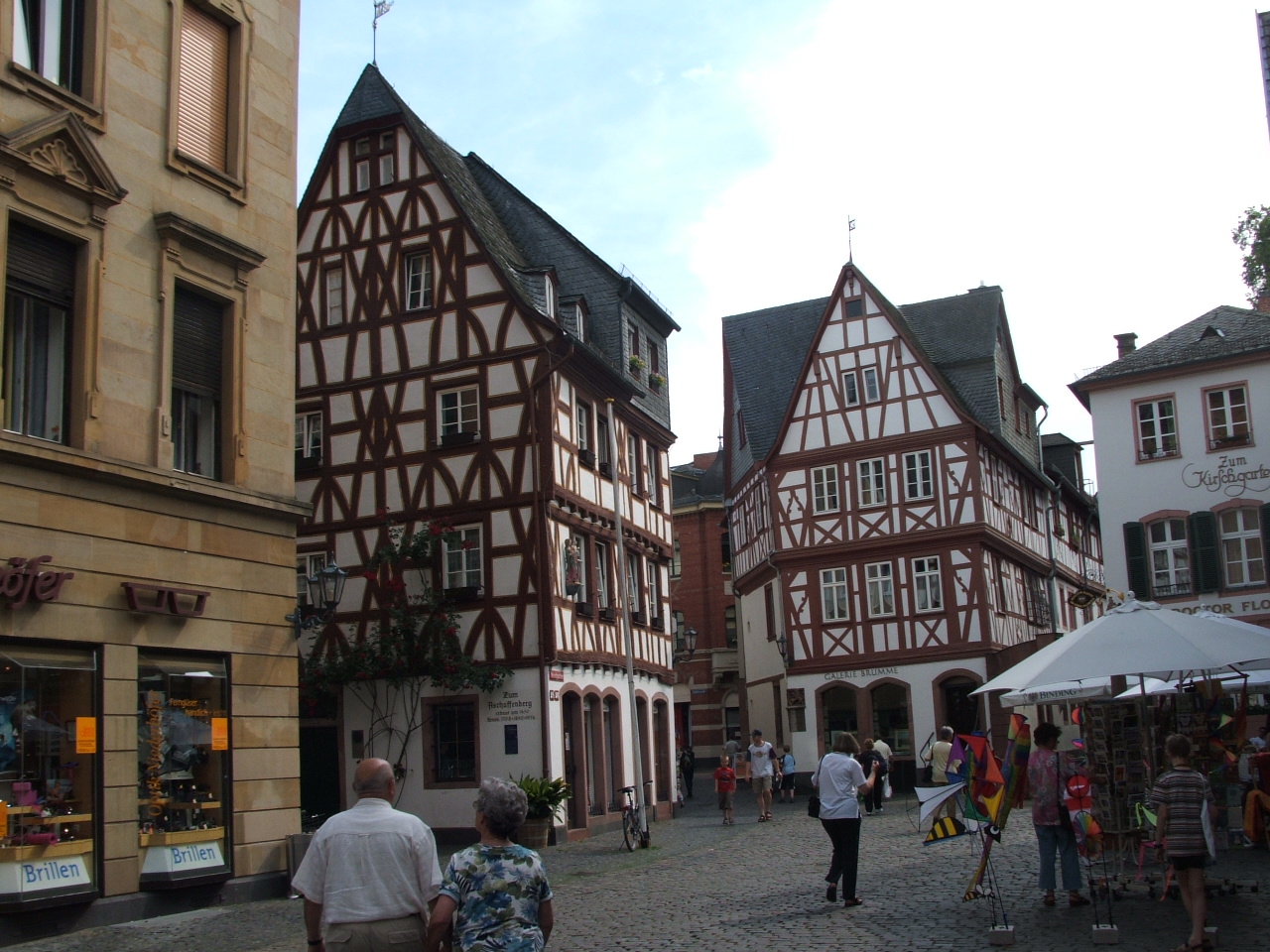
I’ve posted up some pictures of Mainz, a mediaeval town on the banks of the Rhine in Western Germany, about a hundred miles from France, Luxemburg and Belgium.
Named after Johannes Gutenberg, the father of modern printing, the university was established in 1477. It now has 34,000 students and is unusual among ancient universities in offering nearly all its facilities on a single campus. Most mediaeval universities in Europe are scattered across various sites in town.
If I want to get on this course I’m going to have to bring my German up to scratch massively. My fluency has improved since I read the Christiane F memoir. Dictionary in hand, I copied every single word I wasn’t entirely sure of into a thick notebook along with its translation and when this seemed laborious I told myself this is how countless people across the world have learned English...
I’ve reached a point now, where I’m starting to be able to use German practically, which is the whole point of learning a foreign language, surely. I can read German-language websites. It took long enough to get here. But I’ve a way to go before I’m ready for this course...
I would actually get a vocational qualification. I would be qualified to do something at long last! Link: “German in Germany” at Mainz University.
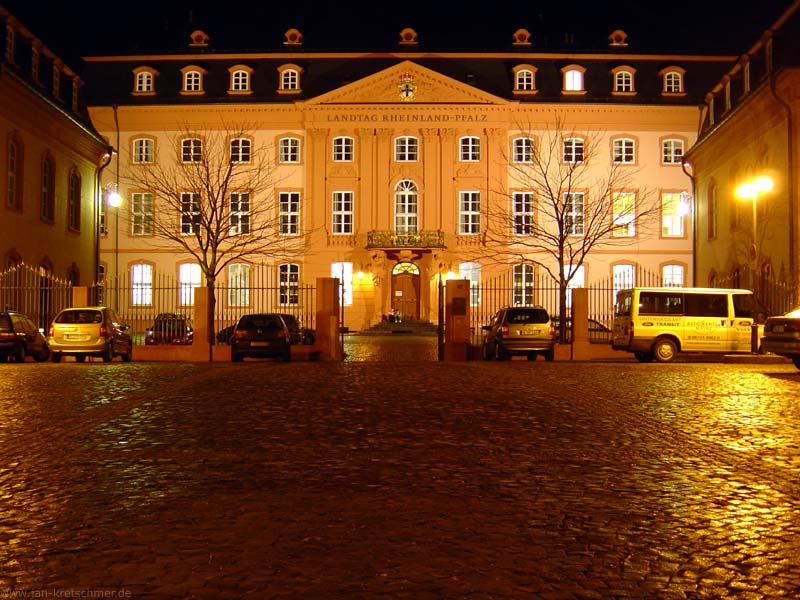
Illustrated top to bottom left-right-left-right: panorama view of town and university; university main foyer; Roman Catholic cathedral; white statue; regional parliament; a tower ~ my ideal home; tudor buildings in Kirschgarten



 I desperately need a copy of Hammer's German Grammar (the standard advanced reference work). My written German is still pretty dire ~ despite my daily blogging attempts. I'm having less and less trouble reading zentraleuropäische books and websites as time goes by, which shows I'm at least making some progress. (And I do know the German for a corpse (eine Leiche), which means I can describe my face in the mirror at six in the morning...)